Friday, December 11, 2009
Ch 10, 11
Thursday, November 19, 2009
Notes on Ch 5-9
Thursday, November 12, 2009
Notes on Ch 3-4
Ch 3: Plane & Space
-just as a line can be bent and turned in an infinite number of directions, a plane has the freedom to be folded and redirected through space one, many, or an infinite amount of times as well. Visual structures in 2-D is called linear, and in 3-D is called planar.
-Only in the past century has planar form and structure leaped to prominence in the 3-D arts. By the early 1900's, designers were pursuing innovative, viable designs of purely planar elements.
-Almost all artists who work with planar constructions begin their ideas as paper studies. Two planar forms can interact in 3 ways: at an edge of a fold, when one abuts the face of another, or when the two planes interpenetrate.
-Architectonic form is a special category of planar form. (geometric shapes, primary emphasis, and interior/exterior)
-Perforations, or holes, allow transitions between closed interior and open exterior spaces. Can be expressed through screens.
-Planar segments accurately describe shapes in 3-D space, differentiating them from the notion of planes of space. Planes of space are the mathematical notion of plane, which extend indefinitely through space.
-Planes divide (activate) and shape space. Planes can also define volume by virtue or their shape.
-Planes can be regarded as 2-D (or graphic) shapes thrust into 3-D space. Graphic qualities of shapes also create expression. Graphic quality divides into two different categories: form and sign.
My thoughts: I actually learned a lot about plane and space from this chapter; it's really interesting that all of 3-D is based on planes, and that 3-D art is based not only on the plane-segment itself, but also on the space around the plane-segment. So, when I (or anyone) make 3-D art, all I'm really doing is gathering several planes and "twisting them in infinite ways" to create a form that will be even further defined by negative space-- and this form can carry rhythm, balance, movement, and any other principle of design you could think of. That's so awesome!!!
Ch 4: Organization
-Organization is the overall pattern or structure that ties the parts of an object together into a united, sensible, and purposeful whole. While 2-D relies on visual structure, 3-D relies on visual AND physical structure.
-Synergy: "the whole is greater than the sum of its parts".
-Order and Freedom: one must choose which to emphasize to achieve their goal. Too much excessiveness in either can result in loss of variety or loss of composition.
-Structure and Unity: grids are the most common examples of systematic structures. Priori = preset logic which governs the relative position/direction/scale of visual elements of a composition. Systematic structure relies on formal applications, while intuitive structure relies on "far less prescriptive applications". Some unifying principles that bind a composition together include balance, repetition with variety, proportion, continuity, focus and emphasis, and economy.
-Balances ensure that two halves of a composition carry the same visual weight-- in 3-D, balance must work from every point of view, though balance may be either symmetric, or asymmetric.
-Symmetry: the most common kind of symmetry in art is mirror symmetry, reflected across a line (or, in 3-D, plane) of symmetry. Another common symmetry is radial symmetry, in which the symmetry is spherical.
-Repetition with Variety: Repetition creates order in a composition. Too much, however, emits a visual drone that blankets interest. Variety is necessary.
-Rhythm and gradation are two important applications of repetition with variety. Both entail the systematic repetition of intervals of change.
-Proportion is the measure of the relative change of scale between elements of a composition.
-Modular proportion limits incremental changes of a scale to a sijavascript:void(0)ngle unit of measure.
-Ratio proportion is based on mathematical ratios.
-Informal proportion is used informally "to refer to the effectiveness of the scale of an object relative to such external factors as its environment or its interaction with the human body."
-Continuity is the visual connection of the forms of an object into linear patterns. Continuity of form results when these paths run through the material components of an object, while continuity of space unifies an object.
-Focus orients the element of a composition towards one spot, while emphasis brings out one part of the composition as dominant.
-Economy is doing as much as possible with as little as possible-- enforces unity through reduction or ensures unity through selection.
-Implied structure guides the deployment of compositional elements without obviously affecting their form, and overt structures' patterns are visually apparent in the structure's form.
-Systematic structures are called "formal" and intuitive structures are called "informal".
-Randomness and Chance: enlivens form and frees it from excessive structure.
-Man-made techniques for randomizing compositional order are called "aleatory" (meaning gambling), like flipping a coin.
-Randomness is still a category of order, but lacks predictability.
My thoughts: There's SO MUCH organization that goes into making art-- I had no idea. It makes me a little bit sad that I've been missing out on all the order that's involved-- it's so important that you use structure (systematic or intuitive) to unify the piece. Unity is also important; it brings the entire thing together-- it's what you see as a whole, instead of as parts. Balance is still kind of a difficult concept for me to grasp, but I think as I continue reading this book, I'll start to understand. And who knows, maybe this book will actually help me grow as an artist.
Tuesday, November 3, 2009
post11: AP-3D Assignment
Sadly, I don't really know what either of those two really are.
We can use any medium (yes!) and any subject (yes!), for which i'm very thankful.
Later, I will post up some brainstorms:
(to be edited later)
Monday, November 2, 2009
post10: AP-3D book
Um, so far I've only read Chapter 1, but it wasn't a complete drag, fortunately. The chapter was sort of an introduction to 3-D arts, and "Identifying the Problem", which I still don't really understand... What problem??
Since we have to take notes and whatever, and since I have a horrible, incurable habit of losing papers, I'm going to back those notes on Chapter 1 up onto this blog. For security purposes. I'll try to do that later tonight.
Chapter 2 is on Space and Form, which is the focus of our next breadth assignment in AP-3D. I hope I learn a sufficient amount about form and (negative) space-- I probably have to grasp these concepts pretty well to be able to base an entire art piece around two specific principles of design.
Sunday, November 1, 2009
Friday, October 30, 2009
post 09: Hyperrealism
Woooooo.
"Hyperrealism is a genre of painting and sculpture resembling a high resolution photograph. Hyperrealism is a fully-fledged school of art and can be considered as an advancement of Photorealism by the methods used to create the resulting photorealistic paintings or sculptures. The term is primarily applied to an independent art movement and art style in the United States and Europe that has recently developed since the early 2000s. However, many Photorealists are also considered Hyperrealists."
Thursday, October 29, 2009
post 08: Julian Beever
post 07, i guess...
H'okay. Another photorealistic sculptor: Patricia Piccinini. She's not so much into making human forms-- she seems more into making weird creatures and automotive-objects (pretty gross). She is also Australian, and was born in 1965. She gained recognition in Australia in the 1990's, and in 2003, was selected as the artist to represent Australia at the Venice Biennale.
.jpg)


Ugh! I mean, wtf(reak) is that junk?!
post06 (but not really)
He is an awe-inspiring, hyperrealist sculptor who began his career making props and models for movies. and stuff. Even cooler-- he's Austrailian! I wish I could find out exactly what he uses to make such realistic sculptures.. a few are made of silicone, and the rest are "mixed media". Maybe the mixed media means silicone and wax? Hmm.
Tuesday, October 27, 2009
post05 (I guess?)
Wednesday, October 21, 2009
post04

Also, here is a GOOD example of an assemblage piece which I should have looked to for reference back when we were working on assemblage-artworks in AP-3D. It was also in the 2008 Scholastic National Art & Writing Awards, titled "Geared Up". It was made by Eric Griffin.
post03 part 2
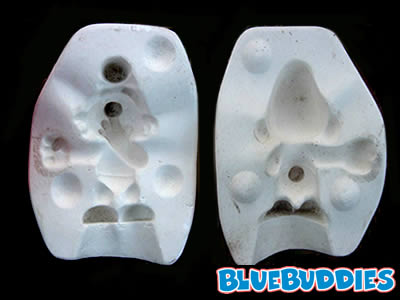
Here's the process of making part 2 of plaster mold-- it's REALLY simple:
(You'll only need the same materials from plastermold-part1)
First, Get your completed plastermold-part1. You should easily be able to take the object out of the mold, but in order to make part 2, you have to stick it back into the mold.
Using clay, build walls around the mold, the same way you built walls around the cube/rectangular-prism in plastermold-part1. There should be no cracks, weak spots, crevaces, or any areas through which the plaster can escape.
Using the brush, apply Murphy's Oil-Soap onto the object and the inner walls of plastermold-part2. This is, again, your release agent.
Carefully pour the plaster into your box-thing. This plaster will become part 2 of your plaster mold.
Wait overnight... again.
The next day, remove the clay above a trashcan, again, and take your object out of the plaster molds.
VOILA! Enjoy.
post: inspirations
Friday, October 16, 2009
post03 part 1
First you gather all the materials: the object of your choice (preferrably small, smooth, hard, and compact-- no fibers or hairs), clay (does not have to be absolutely plastic), plaster mix (that's a whole different story. you just take the plaster and mix it into water in the right proportions), Murphy's Oil-Soap (it's a wood-floor cleaner, and our release agent), a brush (not too small), and a lot of luck, because it's likely you'll mess up the first (or second or third) time(s).
Take the clay and beat it into a cube/rectangular-prism. The clay does have to have enough plasticity so that you can push your object into the clay. The cube/rectangular-prism should be tall enough to where you can push your object halfway into the clay, and there will still be an inch of clay around and below the object.
Now you push your object halfway into the clay.
Build up walls (at least half an inch thick) around the cube/rectangular-prism. The wall should be a decent height, taller than the top of the object. Just keep in mind you will be pouring the plaster into the grave-thing you've just constructed.
Brush the Murphy's Oil-Soap directly onto the object and the inside walls of the clay-grave-thing.
Pour the plaster into the grave-thing. (Lightly!) tap it with your brush to make any bubbles below the surface rise. Not too hard, though.
Wait for about a day for the plaster to dry. Take off the clay, and stick that junk in a trash can. Just keep your object and the plaster mold.
This concludes the making of plaster mold part 1. I'll update later with part 2.
Tuesday, October 13, 2009
post02
I am currently making a mold of a little ducky in my AP 3-D art class. The process is very complicated and I will explain it later. I can't wait till this project is OVER!
Monday, October 12, 2009
post01.
Um, okay. Hi, I'm Grace. I'm 16. I'm Korean-American. I'm actually not sure how I feel about my art, ):
I started out taking an Intro to Art class in my freshman year. I put off Political Science for that Intro class... and I'm paying for it now. In sophomore year, I took Ceramics 1&2 in place of a science course... which I'm also paying for now. Currently in my junior year, I am taking an AP-3D course. My preferred medium of choice is, of course, clay-- I've never even taken a Sculpture class, to be honest.
I'm actually more comfortable with 2-D art than 3-D. I think I first started drawing when I was 6 years old because of my interest in Sailor Moon (no kidding). I guess I just... continued to evolve from there.
This blog is intentially going to be devoted to mainly 3-D artworks, but I have to admit-- my favorite artist is Salvador Dali. I'm pretty sure he's the artist who stimulated my interest in taking art classes in the first place.
Here are some of his works:


and my favorite:
Wednesday, October 7, 2009
Mother & Child
1. Mother forming the baby from a material-- it is the same material she is made of, and it is connected to her-- a part of herself.
2. A baby inside a blanket held by a stork's beak.
3. Woman's torso with inflamed belly.
4. Hand cradling egg.
5. two sleeping forms underneath a blanket-- one much smaller in size.
6. Child crying over limp form.
7. Russian dolls-- only 2, the mom and the baby.
8. Egg with many cracks, obviously ready to hatch.
9. Crying baby wrapped in blanket, alone.
10. Arms throwing baby into air.